You are currently browsing the archives for the Technical Note category.

Archive for the ‘Technical Note’ Category

A Sensitive Technique for Probing Small Differences in Copy Number Variation

 :: Posted by American Biotechnologist on 10-04-2012

Cytogenic studies over the past 50 years have hinted at the impact that copy number variations (CNVs) can have on phenotypic traits and disease susceptibility. Given the high incidence and clinical impact of CNVs, a precise, rapid and cost-effective method is needed for high-throughput validation of candidate CNV associations and for subsequent routing deployment in diagnostic settings. The predominant method used to validate CNVs in larger population is real-time or quantitative PCR (qPCR), which measures the relative rates of fluorescence increases during the exponential amplification of target and single-copy reference genes. The accuracy and precision of these measurements can be impacted by multiple factors including differences in amplification rates between the target and reference genes, variations in their amplification rates during qPCR, sampling error due to DNA concentration and analysis errors. Weaver et al. rigorously characterized these factors and found that systemic errors can be addressed by increasing the number of replicates to achieve the desired precision. however, the required number of replicates increases rapidly as finer discrimination is desired, with four replicates required to distinguish a twofold difference and up to 18 replicates to distinguish a 1.25-fold difference.

Read Digital PCR – Probing Copy Number Variations Using Bio-Rad’s QX100 Droplet Digital PCR System to learn more on how droplet digital PCR (ddPCR) can be used to determine small fold differences for higher-order CNV states.

Transfering high molecular weight proteins

 :: Posted by American Biotechnologist on 02-20-2012

We are all intimately familiar with protein blotting techniques which have been a cornerstone of the biochemicstry/biology lab for the past 30 years.

As is well known, the efficiency of protein migration is affected by various factors including the size and charge of the protein, and protocol optimization is often needed on a protein-specific basis. In fact, it can be particularly challenging to transfer large molecular weight proteins alongside small molecular weight proteins, as transfer conditions may cause small proteins to blow through the membrane.

Currently there are three popular techniques for protein transfer: the tank transfer, the semi-dry blotting method and the fast blotting “turbo” technique (for transfer within 3-10 minutes).

In the attached paper, Transfer of high molecular weight proteins to membranes: a comparison of transfer efficiency between blotting systems, Bio-Rad Laboratories presents a comparison of the various blotting techniques across a wide range of molecular weights with a particular emphasis on large proteins (more than 200kD).

A primer on fluorescence detection

 :: Posted by American Biotechnologist on 01-31-2012

Yesterday we told you about how to get more data from your western blots by utilizing multiplex fluorescent detection. Today, we will provide you with a primer on fluorescent detection taken from the Bio-Rad Laboratories Protein Blotting Guide.

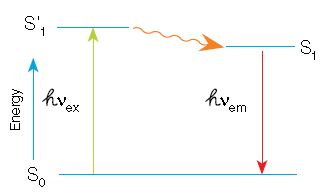
In fluorescence, a high-energy photon (ℎVex) excites a fluorophore, causing it to leave the ground state (S0) and enter a higher energy state (S’1). Some of this energy dissipates, allowing the fluorophore to enter a relaxed excited state (S1). A photon of light is emitted (ℎVem), returning the fluorophore to the ground state. The emitted photon is of a lower energy
(longer wavelength) due to the dissipation of energy while in the excited state.

When using fluorescence detection, consider the following optical characteristics of the fluorophores to optimize the signal:

  • Quantum yield — efficiency of photon emission after absorption of a photon. Processes that return the fluorophore to the ground state but do not result in the emission of a fluorescence photon lower the quantum yield.Fluorop hores with higher quantum yields are generally brighter
  •  

  • Extinction coefficient — measure of how well a fluorophore absorbs light at a specific wavelength. Since absorbance depends on path length and concentration (Beer’s Law), the extinction coefficient is usually expressed in cm–1 M–1. As with quantum yield, fluorophores with higher extinction coefficients are usually brighter
  •  

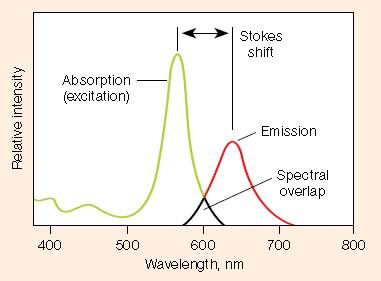
  • Stokes shift — difference in the maximum excitation and emission wavelengths of a fluorophore. Since some energy is dissipated while the fluorophore is in the excited state, emitted photons are of lower energy (longer wavelength) than the light used for excitation. Larger Stokes shifts minimize overlap between the excitation and emission wavelengths, increasing the detected signal
  •  

  • Excitation and emission spectra — excitation spectra are plots of the fluorescence intensity of a fluorophore over the range of excitation wavelengths; emission spectra show the emission wavelengths of the fluorescing molecule. Choose fluorophores that can be excited by the light source in the imager and that have emission spectra that can be captured by the instrument. When performing multiplex western blots, choose fluorophores with minimally overlapping spectra to avoid channel crosstalk
  • For more information be sure to download the Protein Blotting Guide from Bio-Rad Laboratories.

Protein blotting guide for novice and advanced users

 :: Posted by American Biotechnologist on 11-15-2011

Protein blotting is a staple technique of most molecular biology and proteomics laboratories. In previous posts, we discussed topics such as semi-dry protein transfer and protein transfer methods, and we even did a multi-part series on western blotting.

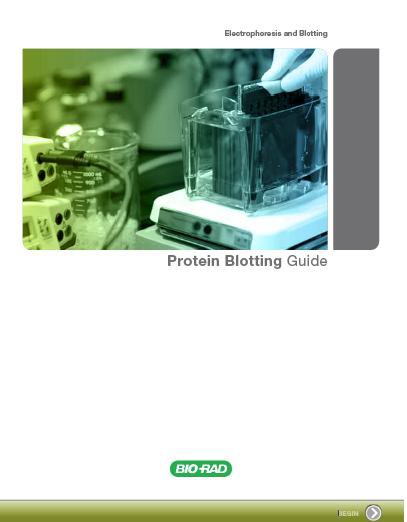
Now, we are proud to present you with a 43 page protein blotting guide put together by Bio-Rad Laboratories. The guide is organized into two parts which cover the theory and methods behind protein blotting. You will learn topics such as methods and instrumentation, the difference between various membranes and tranfer buffers, the ins and outs of transfer conditions, detection and imaging and a host of different blotting and detection protocols.

The guide is fairly technical and is appropriate for both novice and advanced users alike.

Click on the link to download the Protein Blotting Guide now.

Strategies for proteomics sample preparation

 :: Posted by American Biotechnologist on 10-25-2011

Two-dimensional (2-D) gel electrophoresis is a popular and proven separation technique for proteome analysis. The 2-D procedure is straightforward: Proteins are first separated according to their isoelectric point (pI) by isoelectric focusing (IEF) and then by their molecular weight by SDS-PAGE. For most researchers, 2-D gel electrophoresis is easy to learn, because advances in immobilized pH gradient (IPG) technology have eliminated the need for tricky and tedious IEF in ampholyte gel gradients. Nevertheless, problems with smearing, streaking, and poor resolution and reproducibility tend to leave researchers dissatisfied with the results of 2-D experiments. These common compalints are often due to improper sample preparation.

One of teh most undervalued aspects of the 2-D process, sample preparation prior to the first-dimension IEF separation contributes significantly to the overall reproducibility and accuracy of protein expression analysis. Some important considerations include:

  • Care must be taken to prevent protolysis during protein extraction, and proteins must be solubilized in a buffer that is compatible with IEF
  • Contaminants such as salts and detergents must be removed to ensure successful separation
  • Fractionation is essential to reduce protein sample complexity when analysis of subpopulations or low-abundance proteins is required

Without proper sample preparation, protein precipitations, gel streaking, and overall poor resolution are often the unfortunate result.

Click on this link to learn some great strategies for proteomic sample preparation.

Click to learn about Bio-Rad’s new Protean i12 IEF Cell.