
Posts Tagged ‘Proteomics’

Accelerating the discovery of the hammers and tongs of life

 :: Posted by American Biotechnologist on 02-25-2013

Researchers at the University of Wisconsin-Madison have found a way to significanlty increase the processing speed at which mass spectrometers identify proteins. Professor Joshua Coon and colleagues from the department of chemistry and biomolecular chemistry, used isotope tags to enable the mass spec to differentiate between as many as 20 different samples at once. The new technology is expected to make mass spec cheaper, faster and more accessible to the scientific masses clamoring to be part of a technique that is on the forefront of biology.

As one astute observer put it:

Proteins are essential building blocks of biology, used in muscle, brain, blood and hormones. If the genes are the blueprints, the proteins patterned on them are the hammers and tongs of life.

With Coon’s new technology, the discovery of the hammers and tongs have life has just been kicked up a notch.

For more information, read Analytical trick may accelerate cancer diagnosis.

DO YOUR PROTEINS HAVE THEIR OWN SOCIAL NETWORK?

 :: Posted by American Biotechnologist on 07-09-2012

Diseases are the result of underlying system interactions NOT simply physical underpinnings. Watch the following talk from Northeastern University Professor Albert-László Barabási to learn how mapping cellular protein reactions can help us discover how diseases work.

Keeping it constant: A lesson in protein transfer

 :: Posted by American Biotechnologist on 05-22-2012

Power supplies that are used for electrophoresis hold one parameter constant (either voltage, current, or power). The PowerPac™ HC and PowerPac Universal power supplies also have an automatic crossover capability that allows the power supply to switch over to a variable parameter if a set output limit is reached. This helps prevent damage to the transfer cell.
During transfer, if the resistance in the system decreases as a result of Joule heating, the consequences are different and depend on which parameter is held constant.

Transfers Under Constant Voltage
If the voltage is held constant throughout a transfer, the current in most transfer systems increases as the resistance drops due to heating (the exception is most semi-dry systems, where current actually drops as a result of buffer depletion). Therefore, the overall power increases during transfer, and more heating occurs. Despite the increased risk of heating, a constant voltage ensures that field strength remains constant, providing the most efficient transfer possible for tank blotting methods. Use of the cooling elements available with the various tank blotting systems should prevent problems with heating.

Transfers Under Constant Current
If the current is held constant during a run, a decrease in resistance results in a decrease in voltage and power over time. Though heating is minimized, proteins are transferred more slowly due to decreased field strength.

Transfers Under Constant Power
If the power is held constant during a transfer, changes in resistance result in increases in current, but to a lesser degree than when voltage is held constant. Constant power is an alternative to constant current for regulating heat production during transfer.

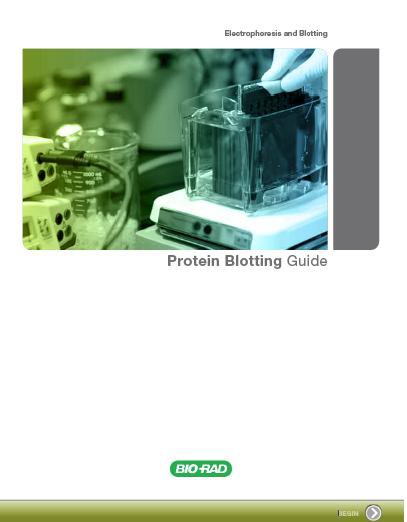
The above information was adapted from Bio-Rad’s protein blotting guide. For more great information, be sure to download the Protein Blotting Guide from Bio-Rad Laboratories.

Top 8 reasons for high background noise on your western blot

 :: Posted by American Biotechnologist on 05-02-2012

The following are the top 8 causes for overall high background on your western blot and potential solutions:

  1. Blocking was incomplete
    • Increase the concentration of blocker
    • Increase the duration of the blocking step
    • Use a different blocking agent
  2. Blocker was impure
    • Use a pure protein such as BSA or casein as a blocker
  3. Wash protocols were insufficient
    • Increase the number, duration, or stringency of the washes
    • Include progressively stronger detergents in the washes; for example, SDS is stronger than Nonidet P-40 (NP-40), which is stronger than Tween 20
    • Include Tween 20 in the antibody dilution buffers to reduce nonspecific binding
  4. The blot was left in the enzyme substrate too long (colorimetric detection)
    • Remove the blot from the substrate solution when the signal-to-noise level is acceptable, and immerse in diH2O
  5. Contamination occurred during electrophoresis or transfer
    • Discard and prepare fresh gels and transfer solutions
    • Replace or thoroughly clean contaminated foam pads if a tank blotter was used
  6. Excessive amounts of protein were loadedon the gel or too much SDS was used inthe transfer buffer. Proteins can pass through the membrane without binding and recirculate through a tank blotting system.
    • Reduce the amount of protein on the gel or SDS in the transfer buffer
    • Add a second sheet of membrane to bind excess protein
  7. The primary or secondary antibody was too concentrated
    • Increase antibody dilutions
    • Perform a dot-blot experiment to optimize working antibody concentration
  8. Incubation trays were contaminated
    • Clean the trays or use disposable trays

For more great information, download the protein blotting guide from Bio-Rad Laboratories.

Bio-Rad’s PROTEAN i12 IEF system wins Laboratory Equipment’​s Reader’s Choice Award

 :: Posted by American Biotechnologist on 03-13-2012

Hercules, CA — March 13, 2012 — Bio-Rad Laboratories, Inc.’s PROTEAN i12 IEF system won a Laboratory Equipment Readers’ Choice Award in the Basic Lab Equipment category. Theaward will be presented today at a special reception during the Pittcon Conference & Expo 2012 being held at the Orange County Convention Center in Orlando, FL.

“The PROTEAN i12 IEF system individually controls each of its 12 lanes, allowing researchers to generate reproducible 2-D gels in less time and with total confidence,” said Renee Lemaire-Adkins, Bio-Rad Marketing Manager, Lab Separations Division. “It is a great honor to have our IEF technology recognized by the researchers and laboratory professionals who compose Laboratory Equipment’s readership.”

The 4th annual award celebrates “excellence in product design and performance for the tools and materials used by scientists and engineers in research laboratories.” Laboratory Equipment readers voted for products online.

The PROTEAN i12 IEF system is the industry’s only isoelectric focusing (IEF) system designed to simultaneously run up to 12 immobilized pH gradient (IPG) strips in 12 independently programmed lanes, which allows users to confidently run 12 different conditions at one time. Although many available IEF systems have multiple lanes, all but the PROTEAN i12 system depend on a single power supply, allowing only one set of conditions to be run at a time.

By independently controlling voltage and current levels in each lane, the PROTEAN i12 IEF cell allows users to optimize different sample and pH conditions and run samples from different experiments simultaneously.The independent lane control prevents lane-to-lane sample interference, resulting in faster, more accurate, reliable, and reproducible focusing.

Visit http://bit.ly/proteani12pr or Bio-Rad’s Pittcon Booth #1412 to learn more about the PROTEAN i12 IEF system. You can find more about the Laboratory Equipment Reader’s Choice Award at http://bit.ly/2012readerschoice.