Bio-Rad has sponsored the development of
this site to advance the productivity of the American Biotechnology sector and the fine people who
work in it across the country. We invite readers to contribute content:
posters, tools, research and presentations, articles white papers, multimedia, music
downloads and entertainment, conference announcements, videos. Please contact info@americanbiotechnologist.comfor more information.
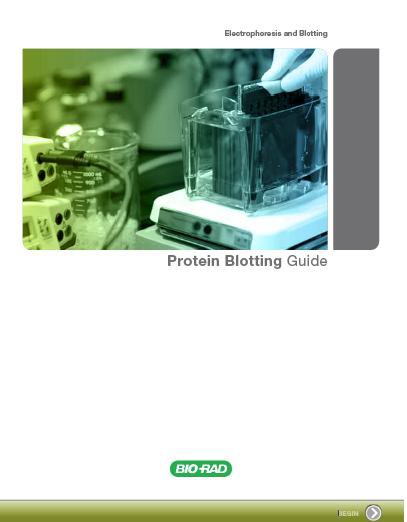
Download the Protein Blotting Guide
Download the Stem Cell Guide for Life Science Researchers
Several years ago, Bio-Rad Laboratories released the highly successful music video “The PCR Song.” The song, which boasts great lyrics and a catchy tune, went viral receiving over 1 Million views since its release. There have been many attempts to copy Bio-Rad’s success and hundreds of knock-off videos have been posted to YouTube. One thing is for sure, The PCR Song has helped spread awareness about PCR technology among the lay public and is inspiring a whole new generation to learn more about cutting edge science.
Here is the latest PCR Song remix posted by budding future scientists:
The results are in from SelectScience’s Scientists’ Choice Award and Bio-Rad Laboratories‘ Trans-Blot® Turbo™ has taken the prize for Best Life Science Product of 2011. Over 30,000 SelectScience members were invited to vote for their favorite product of 2011 and the Trans-Blot Turbo was given the recognition that it deserves.
Click on the picture below to watch the award ceremony.
The introduction of real time PCR (qPCR) revolutionized the world of molecular biology and provided scientists with a tool for obtaining truly quantitative nucleic acid data. While qPCR remains one of the most robust tools available on the bench, its resolution power is limited to changes in DNA concentration that are higher than 50%. This limitation is mainly due to the compounding of errors derived from each step in the quantification process. That’s where Droplet Digital PCR enters the picture.
Droplet Digital PCR alleviates the compounding error effect by partitioning samples into 20,000 droplets such that each copy of DNA is encapsulated in its own bubble. Subsequent amplification reactions are then carried out individually which leads to reduce background noise and therefore a more sensitive measurement of low concentrations of nucleic acid that may not have been detectable using qPCR.
Bio-Rad Laboratories‘ Frank Bizouarn recently published an outstanding article in Genetic Engineering and Biotechnology News detailing the benefits of ddPCR including a real life example. The article covers how ddPCR works and its use in gene-expression analysis, copy number variation determination and rare event detection.
The following are the top 8 causes for overall high background on your western blot and potential solutions:
Blocking was incomplete
Increase the concentration of blocker
Increase the duration of the blocking step
Use a different blocking agent
Blocker was impure
Use a pure protein such as BSA or casein as a blocker
Wash protocols were insufficient
Increase the number, duration, or stringency of the washes
Include progressively stronger detergents in the washes; for example, SDS is stronger than Nonidet P-40 (NP-40), which is stronger than Tween 20
Include Tween 20 in the antibody dilution buffers to reduce nonspecific binding
The blot was left in the enzyme substrate too long (colorimetric detection)
Remove the blot from the substrate solution when the signal-to-noise level is acceptable, and immerse in diH2O
Contamination occurred during electrophoresis or transfer
Discard and prepare fresh gels and transfer solutions
Replace or thoroughly clean contaminated foam pads if a tank blotter was used
Excessive amounts of protein were loadedon the gel or too much SDS was used inthe transfer buffer. Proteins can pass through the membrane without binding and recirculate through a tank blotting system.
Reduce the amount of protein on the gel or SDS in the transfer buffer
Add a second sheet of membrane to bind excess protein
The primary or secondary antibody was too concentrated
Increase antibody dilutions
Perform a dot-blot experiment to optimize working antibody concentration
Using Bio-Rad’s TC10 automated cell counter is a breeze! Watch this video and learn how to use the TC10 counter to count cells in less than 30 seconds before splitting them or running an experiment. He discusses the innovative auto-focus technology and how it helps to increase accuracy and reproducibility.