You are currently browsing the archives for the profiles category.
Bio-Rad has sponsored the development of
this site to advance the productivity of the American Biotechnology sector and the fine people who
work in it across the country. We invite readers to contribute content:
posters, tools, research and presentations, articles white papers, multimedia, music
downloads and entertainment, conference announcements, videos. Please contact info@americanbiotechnologist.comfor more information.
Download the Protein Blotting Guide
Download the Stem Cell Guide for Life Science Researchers
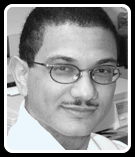
A native of Trinidad and Tobago, Dr Aldrin Gomes decided to specialize in the biochemical differences between normal and diseased hearts in his graduate studies at the University of the West Indies. A significant portion of his research utilized protein separation and purification techniques, making SDS-PAGE electrophoresis and protein blotting an essential tool in most of his experiments. But in a country where resources are scarce, unrelenting heat is destructive to sensitive biological materials, and slow delivery times are common for product orders, Gomes and his colleagues began to analyze the electrophoretic workflow to determine how to make the process as efficient as possible. “Because we performed a lot of electrophoresis, we published some articles whereby we looked at how we could standardize things to improve resolution in our results,” says Gomes. “We heavily researched aliquoting methods, sample buffers (methods for making them and determining actual shelf lives), whether or not buffers can be reused — even minor factors such as gel pouring techniques and plate thickness.”
Since Gomes “grew up,” scientifically speaking, in an environment where experiments must be planned far in advance and resources cannot be wasted, he cultivated the habit of designing experiments and procedures that made the best possible use of tools and time while ensuring optimal results. This followed him through his graduate work and his subsequent career, first as a research associate, then in his current role as assistant professor in the Neurobiology, Physiology and Behavior department in the College of Biological Sciences, and Physiology and Membrane Biology department in the School of Medicine at UC Davis.
George Church, who it may be argued is the father of personalized genomics, spoke at TEDMED about the future of personal genomics and what research has yielded so far. Ironically, when he gave this talk one year ago in October of 2010, a google search of the term “synthetic personal genomes” did not yield any results (according to Dr. Church). The same search done today returns over 900,000 results! Obviously George continues to be light years ahead of the crowd. Have a look at the video below and see for yourself.
George Church is one of the founders of the human genome project and continues to play an important role in the personal genome project, stem cell research and biofuel research. In this video, Dr. Sriram Kosuri, a Postdoctoral fellow in George’s lab at Harvard University discusses the Church lab’s approach to solving problems and developing technologies.
Dr. George Church is a professor of genetics at Harvard and a professor of Health Sciences & Technology at Harvard and MIT. George helped initiate the human genome project in 1994 and has played a pivotal role in molecular genetics ever since. In 2005, Dr. Church initiated the Personal Genome Project which aims to make personal genome sequencing more affordable, accessible, and useful for humankind.
The following educational and entertaining video first aired in July 2009 and has been viewed on YouTube by over 15,000 people. After watching this video, how much closer do you thing George is to accomplishing his goal and how much has changed since this video first aired almost two years ago?
According to the YouTube description: When Carla Shatz, PhD, professor of neurobiology, and Helen Blau, PhD, professor of microbiology and immunology, came to Stanford in 1978, they were two of he first women to be hired on the tenure tract for basic science faculty. Over the decades, as their professional and personal paths have diverged and converged, they have remained the closest of friends. In this video, they discuss the courses their paths have taken and reflect on the rewards and challenges of their lives as women scientists.
Hat tip to the PostDoc Forum for pointing out this video.